




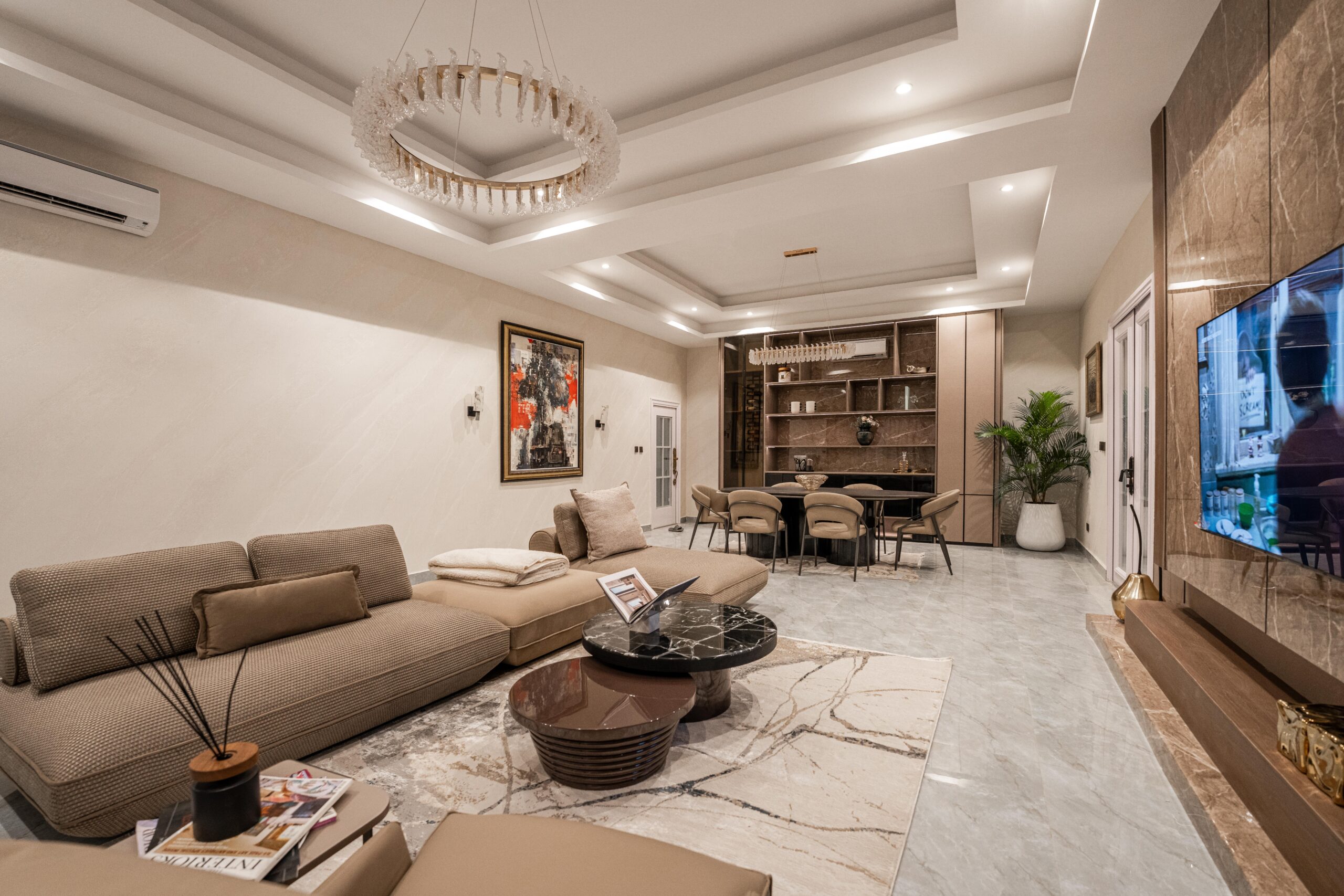
How to Create Warm, Personality-Driven Spaces in 2026 (Moving Beyond Stark Minimalism)
The cold, bare rooms that once felt aspirational are quietly losing their hold. In 2026, the most compelling Nigerian interiors are warm, layered, and unmistakably lived-in ; full of heirlooms, texture, and the particular personality of the people who call them home.
If you’ve been scrolling through Lagos design accounts lately and noticing something shift; less white plaster and floating shelves, more amber-toned rooms thick with pattern and story; you’re not imagining it. A full-throated design movement is underway, and it feels especially right for the Nigerian home.
We’ve been watching this evolution closely and working with clients across Abuja, Lagos, Port Harcourt, and beyond to translate it into spaces that actually feel like theirs. This guide breaks down what’s happening, why it works, and exactly how to apply it in your home.
Why Minimalism Stopped Feeling Like Enough
Stark minimalism had a long, photogenic run. Clean lines, monochromatic palettes, and rigidly curated surfaces looked extraordinary in magazines and on social media. But many homeowners found that actually living inside these spaces was a different experience entirely; sterile, echo-y, and oddly exhausting.
In the Nigerian context, minimalism carried an additional cultural tension. Our design heritage: Yoruba carved furniture, Igbo uli patterns, the beaded textiles of the Edo kingdom, the bold weaves of the North; doesn’t whisper. It announces. Minimalism asked us to mute those voices, and increasingly, people are choosing not to.
| ✶ TEAL HARMONY INSIGHT We hear this from clients constantly: “The house looks beautiful in photos, but I don’t feel comfortable in it.” That dissonance between aesthetic performance and lived comfort is the exact gap that warm, personality-driven design exists to close. |
The interiors that are generating the most excitement right now are ones that feel like they were assembled over a lifetime: a raffia stool picked up in a Benin market next to a velvet accent chair; a gallery wall that mixes a grandmother’s portrait with hand-dyed Adire fabric; walls in deep, saturated colour that feel cool in the afternoon heat but glow gold by evening lamplight.
Enter “Grandma Chic” ; and Why It’s Perfect for Nigerian Homes
The term “grandma chic” ; also called “granny chic” internationally ; refers to a deliberate aesthetic embrace of the things your grandmother’s sitting room had in abundance: crocheted throws, heavily patterned upholstery, porcelain figurines, heavy drapes, mismatched china, and rooms that felt full of memory.
In a Western context, this is partly nostalgic reclamation. In the Nigerian context, it’s something deeper: it’s cultural homecoming. The Nigerian grandmother’s parlour has always been rich with texture and meaning ; the good china reserved for visitors, the Ankara cushion covers changed for celebrations, the carved wooden stool that belonged to her mother, the dried flowers no one dares to throw away.
| “The Nigerian grandmother’s parlour was never a design problem to be solved. It was a living archive ; and 2026’s most exciting interiors are finally recognising that.” TEAL HARMONY DESIGN PHILOSOPHY |
How to Apply Grandma Chic Without Chaos
The goal isn’t to recreate every item in storage untouched ; it’s to curate with intention. Think of yourself as a museum curator, not a hoarder. Each piece earns its place by contributing colour, texture, memory, or beauty.
- Choose one dominant “hero” heirloom. A grandfather clock, a carved wooden settee, or a large aso-oke tapestry becomes the gravitational centre of the room. Design around it, not against it.
- Mix patterns with a unifying colour. Grandma chic thrives on pattern-mixing ; but anchor the chaos with one colour that appears in every pattern. Deep green, warm terracotta, and burnt amber all work beautifully.
- Layer your textiles. Throw a crochet blanket over a velvet sofa. Stack patterned cushions. Let curtains pool slightly on the floor. Layering signals comfort and permanence.
- Display, don’t hide. Open shelving with books, ceramics, and small objects tells more story than closed cabinetry ever will.
- Include something imperfect. The slight fade on a cushion, the chip on a ceramic pot ; imperfection is the signature of a life actually lived. Don’t iron it out.
The “Collected Over Time” Aesthetic ; Curated, Not Chaotic
The most admired interiors in 2026 don’t look like they were purchased in a single shopping trip. They look assembled over years ; a piece from this trip, a gift from that person, a find from a Saturday market visit three years ago.
This “collected” quality is one of the hardest things to fake and one of the easiest things to achieve authentically ; because you’ve already been doing it. The Kano leather pouffe from a work trip. The wooden mask from a family friend. The hand-painted bowl you bought impulsively and aren’t sure why.
The design task is not to go out and buy more. It’s to surface what you already have, give it space and intention, and stop apologising for it.
Building Your Collected Aesthetic: A Framework
| LAYER ONE ; THE ANCHOR Large furniture pieces that define the room’s personality. Choose one statement material: natural rattan, dark-stained wood, aged leather, or richly upholstered velvet in a deep colour. |
| LAYER TWO ; THE WARMTH Medium-scale objects that add texture and organic life. Woven baskets, terracotta pots, large-leafed tropical plants (which thrive naturally in Nigerian climates), and handmade ceramics from local artisans. |
| LAYER THREE ; THE STORY Small, personal objects that hold memory. Framed photographs, travel souvenirs, a stack of meaningful books, inherited trinkets. These should look slightly too much ; that’s how you know it’s working. |
The magic happens when all three layers co-exist without one dominating completely. Stand back from a finished room: if your eye knows where to start but wants to keep exploring, you’ve got it right.
Moodier Palettes for Nigerian Homes and Climates
One of the persistent myths about interior design in tropical climates is that you must use light colours to keep rooms feeling cool. This is partly true ; and entirely misunderstood.
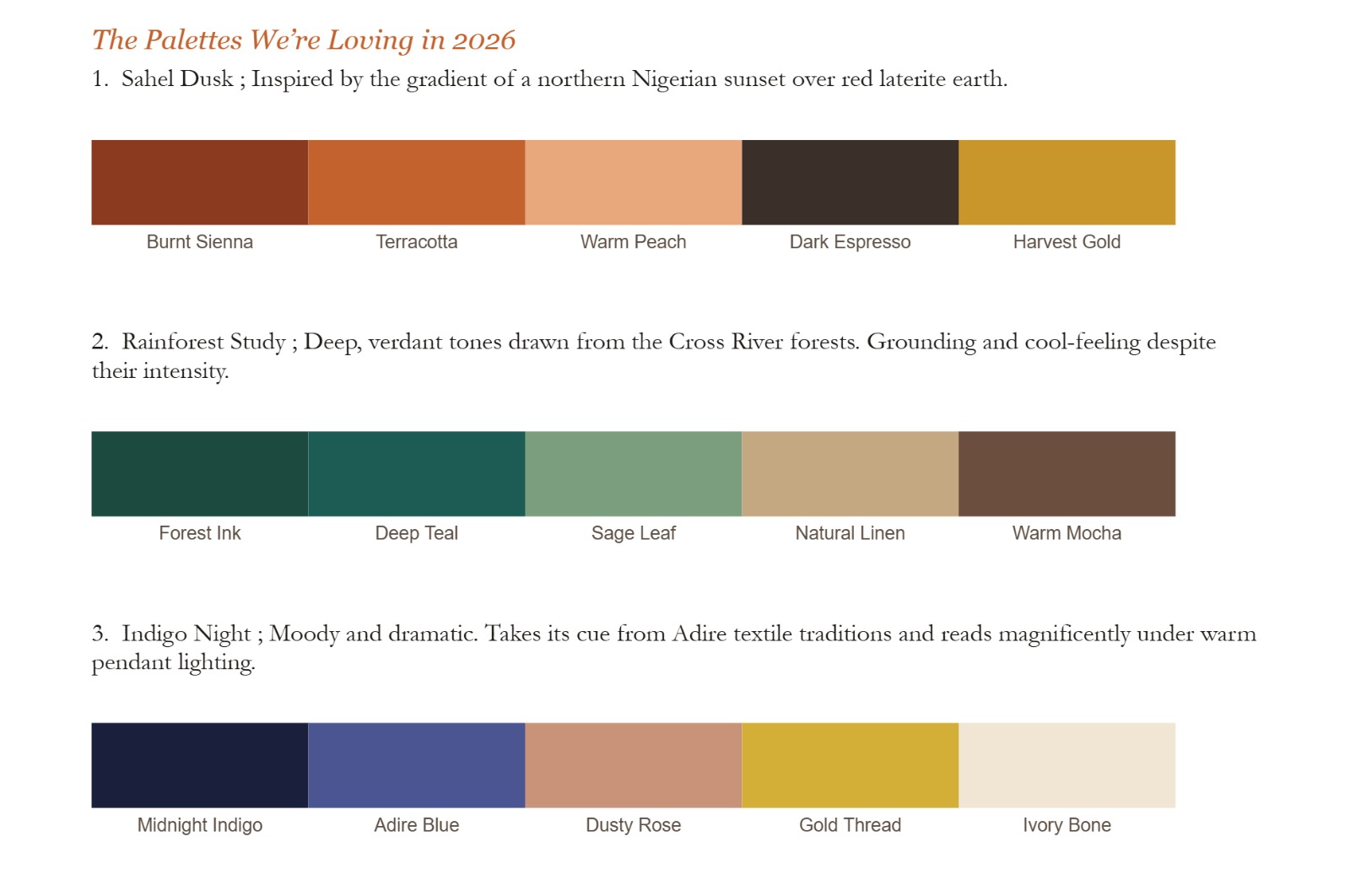
Thermal mass, ventilation, and window treatment do far more for room temperature than wall colour ever will. Meanwhile, light, bright interiors often glare uncomfortably in Nigeria’s intense equatorial light. A room painted in deep forest green, warm terracotta, or moody plum can actually feel more restful and visually “cooler” than a stark white room drowning in reflected sunlight.
Working with Nigerian Sunlight
Nigeria’s light is intensely directional and high-contrast ; especially in the dry season. This creates both a challenge and an opportunity for moodier palettes. The challenge: deep colours can feel very dark in north-facing rooms or during harmattan’s diffuse, hazy light. The opportunity: when warm late-afternoon light pours through a window into a terracotta or forest-green room, the effect is extraordinary ; walls seem to glow from within.
- Test your colour at 6pm, not noon. Moody colours reveal their true personality in evening light. Paint a large swatch and observe it across the full day before committing.
- Use warm-spectrum artificial lighting. LED bulbs in the 2700K–3000K range enhance terracotta, amber, and ochre tones beautifully. Cool white LEDs flatten and kill warm palettes.
- Layer your window treatments. Sheer curtains filter the harshest midday glare while preserving light; heavier drapes in a complementary colour add drama and thermal comfort.
- Balance with natural materials. Rattan, wicker, natural cotton, jute, and unsealed wood all have warm undertones that harmonise with moody palettes and prevent rooms from feeling oppressive.
Practical Room-by-Room Guide for the Nigerian Home
The Living Room (Parlour)
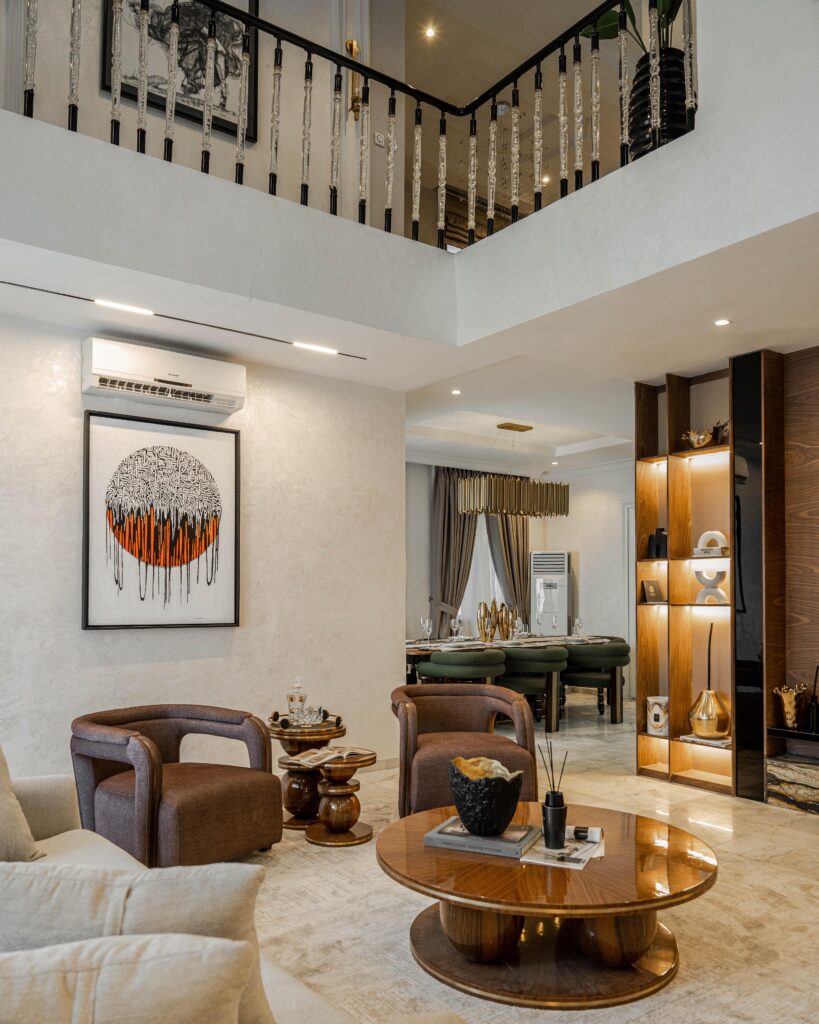
This is the room that does the most social work in the Nigerian home ; receiving guests, celebrating occasions, hosting family. It deserves your boldest choices. Paint the walls in your most dramatic colour. Invest in upholstery with pattern and substance. Dedicate one wall to a gallery of framed family photographs, artwork, or a large textile piece. Add a bowl of fresh garden eggs or ornamental gourds as your centrepiece ; seasonal, free, and deeply rooted.
The Bedroom
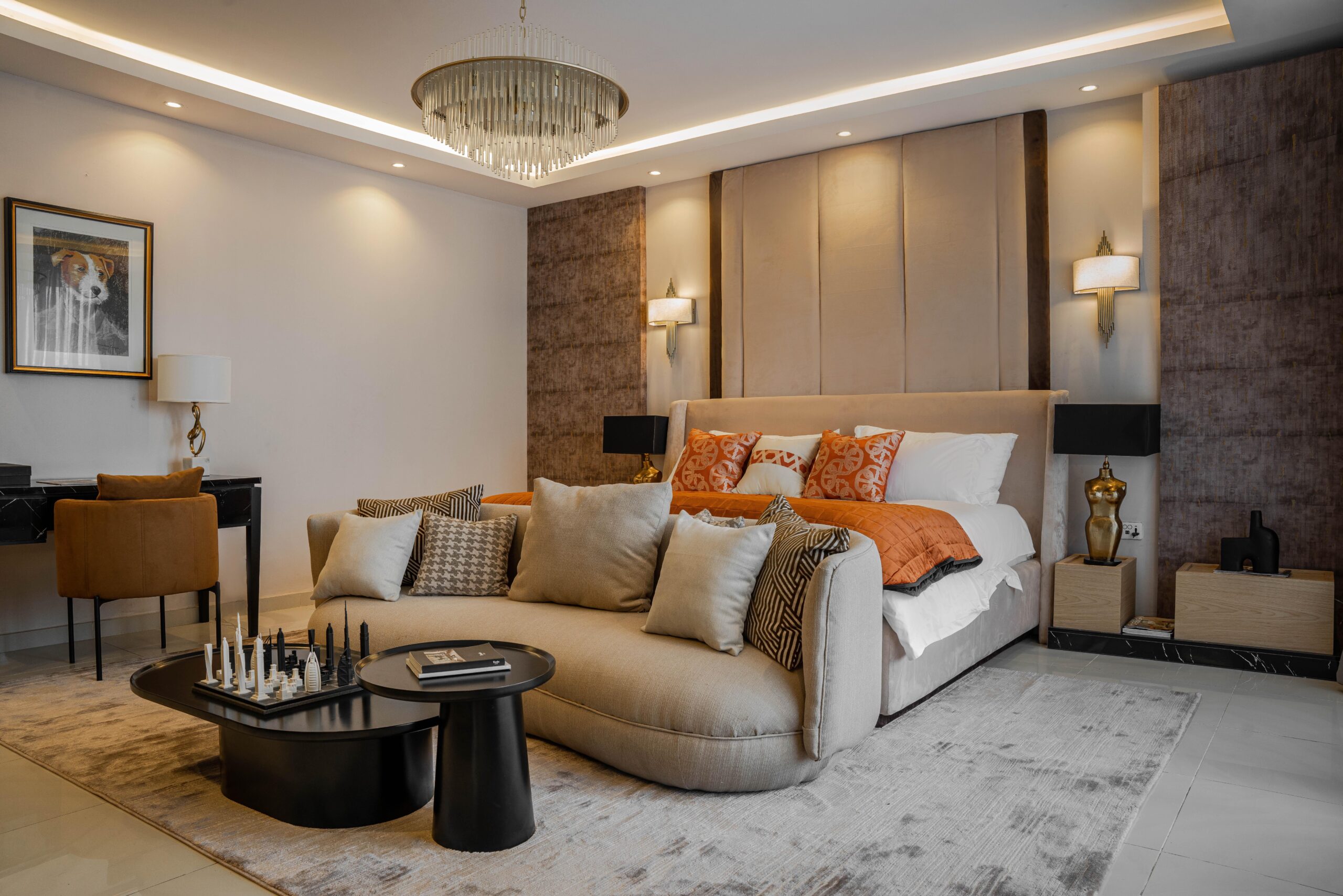 The bedroom is where moody palettes feel most transformative. A room painted in deep forest green or midnight indigo ; with heavy, layered curtains and warm lamp light, creates a genuine sense of sanctuary and retreat. Resist the urge to match everything. Layer your textiles: a woven throw, embroidered pillows, a vintage-style headboard with aged brass fittings.
The Dining Room
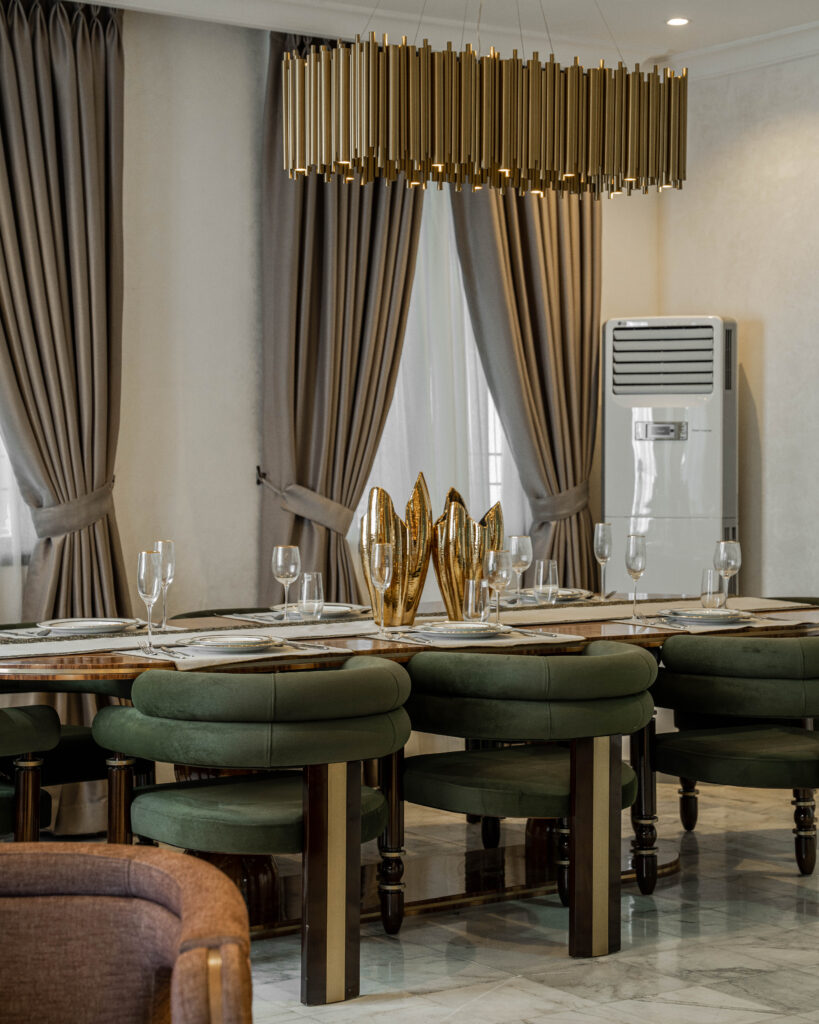
Nigerian dining is ceremonial. The table deserves to look like it. Consider a dark, richly stained hardwood table (iroko, mahogany, or a reclaimed piece) paired with upholstered chairs in a contrasting colour. A large pendant light in woven rattan or beaten copper overhead. Display your best serving platters on open shelving ; they’re too beautiful to hide in a cabinet.
The Home Office
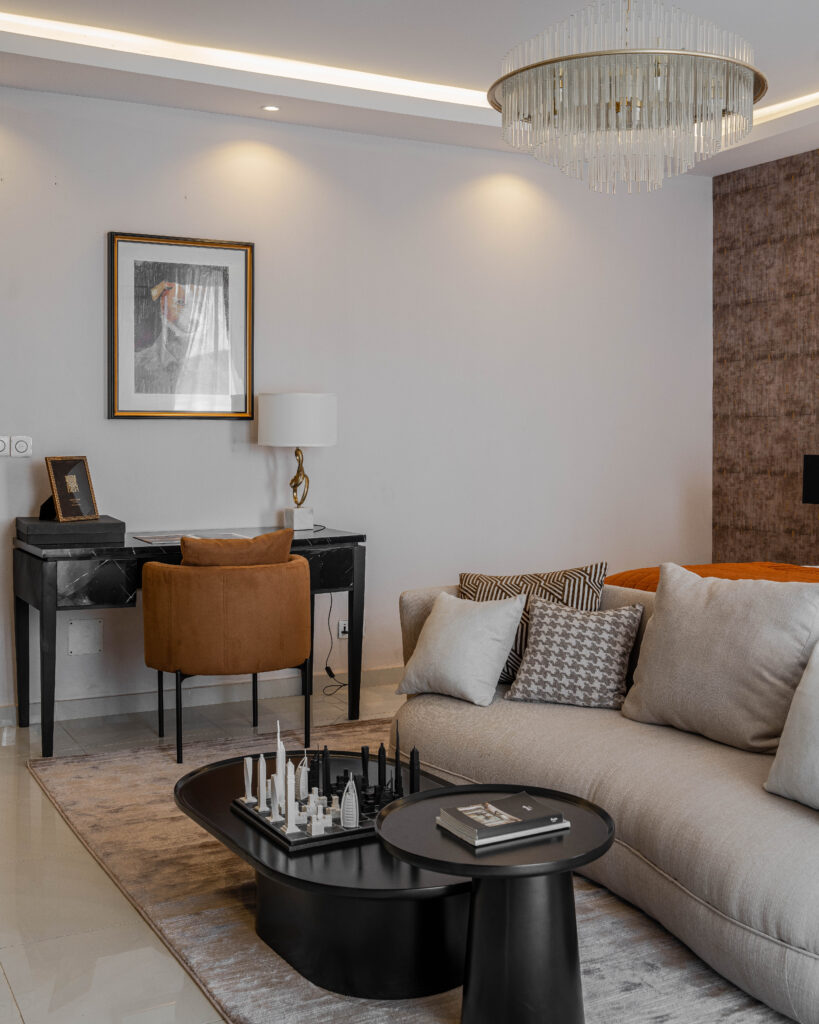
Remote and hybrid work has made the home office a permanent feature in many Nigerian homes. Make yours feel like a scholar’s study rather than a corporate satellite: deep shelving lined with books and meaningful objects, a warm-toned wall colour that helps the mind settle, and a desk lamp in brass or terracotta that creates a pool of focused light.
Where to Source: Finding the “Collected” Look in Nigeria
The collected aesthetic requires sourcing from many places over time ; and Nigeria is extraordinarily rich in exactly the materials this look needs.
- Your local market. Balogun in Lagos, Wuse Market in Abuja, Ogbete in Enugu ; these are treasure stores for woven baskets, carved wooden pieces, ceramic pots, and hand-printed textiles at remarkable prices.
- Nigerian artisan collectives. Makers like Lagos-based ceramic studios, hand-weaving cooperatives in Kano, and furniture craftsmen in Benin City produce exceptional work that carries genuine cultural provenance.
- Family storage. Before you buy anything, go through what’s already in the house. Heirlooms, old textiles, and inherited furniture carry the kind of irreplaceable story no shop can sell you.
- Curated vintage dealers. A growing number of Nigerian sellers on Instagram and Jiji specialise in pre-owned furniture and homeware. The quality can be excellent; the price is almost always better than new.
- Commission custom pieces. Having locally made furniture is often cheaper than imported alternatives and produces something genuinely unique. You can check Teal Culture Showroom for your bespoke furniture.
Your Questions, Answered
Won’t all this layering make my home look cluttered?
Only if the layers compete without a unifying thread. Choose one or two colours that recur throughout the room, and one dominant material that grounds everything. With those anchors, you can layer generously without losing coherence.
Is grandma chic appropriate for modern Nigerian apartments?
Absolutely. The beauty of this aesthetic is its scalability. A two-bedroom apartment in Lekki can express the same warmth and personality as a five-bedroom Maitama home ; it simply requires more intentional editing. Every piece must earn its place; you just have fewer places to fill.
My partner prefers a cleaner look. Can we compromise?
Yes ; and this is one of our favourite design briefs. The goal is warmth, not volume. You can have a relatively clean spatial arrangement but swap cool neutrals for warm ones, add one large textile or statement rug, and include three or four personally meaningful objects. That’s often enough to feel lived-in without overwhelming a minimalism-inclined partner.
Does warm and layered mean hard to clean?
Not necessarily ; but it does require a different approach. Hard surfaces and washable covers on upholstered pieces make maintenance manageable. Choose materials that age gracefully: leather, rattan, and terracotta all look better with a few years of use, not worse.
Design as Cultural Confidence
What’s really happening in 2026’s design landscape isn’t just a trend cycle ; it’s a cultural recalibration. For decades, “aspirational” interiors in Nigeria were defined by external references: European modernism, American open-plan living, the look of a magazine published somewhere else for someone else’s home.
The interiors we’re most excited about right now reject that framework. They’re built from internal references: what our grandmothers kept on their shelves, what our local craftsmen make with their hands, what our climate and light and family structures actually call for.
A home that feels warm, layered, and personality-driven is not a home that has given up on beauty. It’s a home that has stopped looking outward for permission to define it.
That’s a shift worth celebrating ; and decorating for.Top Interior Design Styles in Nigeria for 2026: From Minimalism to Afrocentric Maximalism
| Ready to Design Your Personality-Driven Home? Our team at Teal Harmony Interior Design works with clients across Nigeria to create warm, layered spaces that feel deeply personal. Let’s start with a conversation. BOOK A FREE CONSULTATION – PELUMI@TEALHARMONY.COM |
