




Texture Layering Tips: How Textures & Fabrics Transform a Space
Walk into a room that has been designed with intention and you feel it immediately before you can explain why. More often than not, what you are responding to is texture. The quiet tension between a rough jute rug and a smooth marble coffee table. The warmth of a bouclé sofa against a linen curtain. The way a velvet cushion catches the light differently from the cotton throw beside it. These are the texture layering tips that separate a styled room from a merely furnished one, and they are at the heart of how we approach interior design at Teal Harmony.
In this guide, we break down exactly how to layer textures and fabrics in any room, from a compact Lagos apartment to a sprawling Abuja family home, so that your space feels curated, warm, and entirely intentional.
What This Guide Covers
- Why Texture Layering Is the Foundation of Great Interior Design Nigeria
- The Texture Spectrum: Understanding Contrast
- Texture Layering Tips by Room
- Fabric Choices for the Nigerian Climate
- The Rule of Three: Teal Harmony’s Layering Framework
- Common Texture Layering Mistakes to Avoid
- Your Texture Layering Cheat Sheet
Why Textures and Fabrics are the Foundation of Great Interior Design Nigeria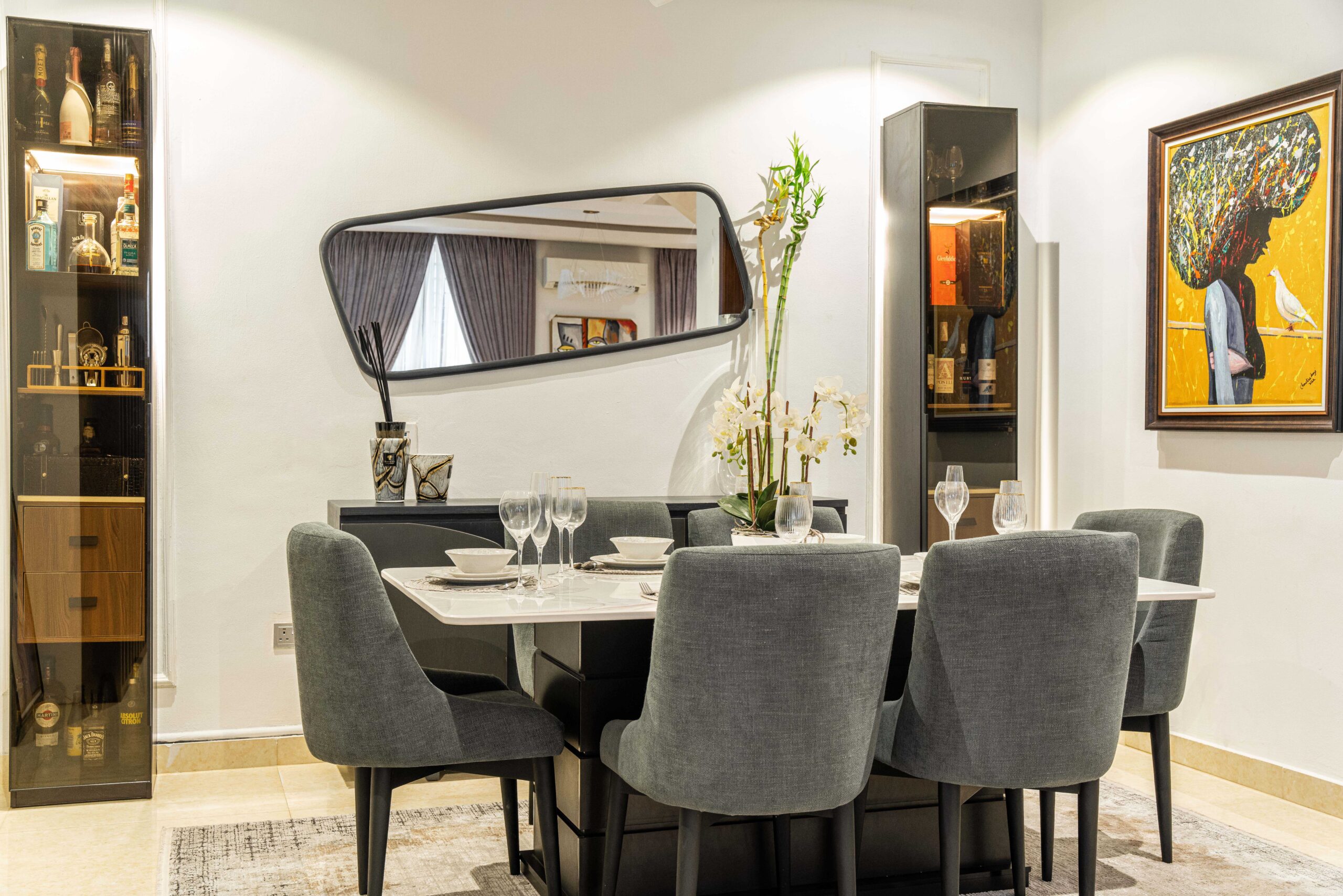
Colour gets most of the attention in interior design conversations, and for good reason. But texture is the quiet force doing the heavy lifting. It is what gives a room its emotional weight, its sense of depth, its ability to feel either cold and sterile or warm and inviting.
In the context of home decor Lagos, texture carries even more significance.
Our light; rich, warm, directional; interacts with surface and material in ways that are distinct from, say, a grey London afternoon. Rough textures absorb and diffuse our strong natural light; smooth, reflective textures bounce it back. Getting this interplay right is one of the key skills of experienced interior designers working in Nigeria.
Texture also does something that no colour can do on its own: it adds dimension to a flat surface. A wall painted a single colour reads differently depending on whether it is smooth plaster, rough limewash, or covered in a woven wall hanging. The colour may be the same, but the texture changes how the room feels entirely.
“A room without texture is like a conversation without depth. It looks fine from a distance, but there is nothing to hold you.”
The Texture Spectrum: Understanding Contrast
Before you can layer textures effectively, you need to understand what you are working with. Textures sit on a spectrum from smooth and reflective at one end to rough and matte at the other. The art of layering is in how you move across this spectrum within a single room.
Smooth and Reflective
- Glass, polished marble, lacquered wood, silk, glossy ceramics
- These surfaces catch and return light — they make a room feel bright, airy, and modern
- Used alone, they can feel cold or clinical
Mid-Range
- Linen, cotton, natural wood grain, leather, painted plaster
- Versatile and grounding — these textures work with almost anything
- The backbone of most well-layered rooms
Rough and Matte
- Jute, sisal, bouclé, raw brick, woven rattan, terracotta, stone
- These surfaces absorb light and add visual weight and warmth
- Essential for grounding a room and preventing it from feeling too polished
A well-layered room typically contains elements from all three zones. If your room feels flat, the most likely cause is that you are living entirely in one zone usually the smooth/mid range. Adding a single rough-textured element (a jute rug, a woven basket, a stone sculpture) can transform the dynamic immediately.
Texture Layering Tips by Room
Living Room
The living room is where texture layering has the most visible impact and the most room to be expressive. Start with your largest surfaces and work inward.
- Floor: a large-format natural fibre rug (jute, sisal, or wool) as the textural anchor
- Sofa: choose a fabric with tactile interest — bouclé, velvet, or textured linen
- Cushions: layer three to five cushions in contrasting fabrics: smooth against chunky knit, linen against velvet
- Window: linen or cotton sheers that filter light while adding softness
- Accent: one rough-textured decorative object — a ceramic vase, woven basket, or driftwood sculpture
Bedroom
The bedroom calls for layering that prioritises comfort and tactile richness above all else.
- Bedding: layer a crisp cotton sheet, a linen duvet cover, and a textural throw (knit or bouclé) at the foot of the bed
- Headboard: upholstered in a fabric with texture — bouclé, velvet, or woven fabric
- Rug: a soft, plush rug underfoot beside the bed — the contrast with harder flooring is itself a textural moment
- Curtains: heavy linen or velvet curtains frame the window and add vertical weight
Dining Room
Dining rooms are often the most underserved when it comes to texture. They tend to be treated as purely functional spaces, but they are among the most sensory rooms in the home — you are touching, tasting, and seeing all at once.
- Table: a natural wood dining table with visible grain is a texture in itself
- Table linen: a textured linen tablecloth or woven runner for everyday use
- Chairs: mixed seating — upholstered chairs at the head, rattan or cane chairs along the sides — creates instant textural variety
- Centrepiece: a cluster of ceramic objects, candles, and dried botanicals
Fabric Choices for Interior Design in the Nigerian Climate
Not all fabrics are equal in the Nigerian context. Our humidity, heat, and the particular quality of our natural light mean that some materials perform and look better than others. Here is a quick reference guide.
| Fabric / Texture | Character | Best Used In | Works Well In |
|---|---|---|---|
| Velvet | Plush, rich | Cushions, curtains | Lagos evenings |
| Linen | Breathable, light | Curtains, bedding | Year-round |
| Bouclé | Textural, warm | Sofas, chairs | Harmattan season |
| Jute / Raffia | Natural, earthy | Rugs, baskets | Year-round |
| Cotton | Crisp, versatile | Throws, cushion covers | Year-round |
| Rattan / Cane | Tropical, airy | Furniture, pendants | All seasons |
One fabric we advise using with care in hot and humid climates is synthetic velvet — it can trap heat and feel uncomfortable. Where you want the look of velvet, opt for cotton velvet or a velvet-cotton blend, which breathes far better than polyester alternatives.
The Rule of Three: Teal Harmony’s Texture Layering Tips Framework
When clients ask us where to start with texture layering, we always return to the same framework: the Rule of Three. In any given room, aim to have at least three distinct textures in play, drawn from different points on the texture spectrum. Here is how it works in practice.
Step 1: Anchor
Choose your anchor texture; the largest, most grounding textural surface in the room. This is almost always the floor treatment (a rug) or the largest piece of upholstery (the sofa). This texture should be from the rough/mid-range zone: jute, wool, bouclé, or textured linen.
Step 2: Bridge
Add a bridge texture — something mid-range that connects your anchor to your accent. Natural wood, smooth leather, matte-painted walls, or crisp cotton all serve this role. This is the texture that stops the room from feeling like a clash of extremes.
Step 3: Accent
Introduce your accent texture — something that creates contrast with your anchor. If your anchor is rough and matte (jute rug), your accent might be smooth and reflective (a glass vase, a polished metal lamp base, a ceramic sculpture). This contrast is what makes the room feel alive.
This three-step approach is deceptively simple, but it produces consistently beautiful results. It works whether you are decorating a single bedroom or redesigning an entire home — and it scales up elegantly as you add more layers.
“Layering texture is not about adding more. It is about adding contrast — and knowing when to stop.”
Common Texture Layering Mistakes to Avoid in Home Decor Lagos
Even with the best intentions, texture layering can go wrong. Here are the most common mistakes we see in home decor across Lagos — and how to correct them.
All Smooth, No Depth
A room fitted with marble floors, glass surfaces, and silk curtains can look spectacular in a magazine but feel cold and unwelcoming in real life. Add warmth with at least one rough-textured element: a jute rug, a basket, or a woven wall hanging.
Too Many Competing Patterns
Texture and pattern are not the same thing, but they interact. A room with three different patterned fabrics and three different textures will feel chaotic. When you are going heavy on pattern, keep your textures more restrained — and vice versa.
Ignoring Scale
Texture has scale as well as quality. A chunky knit throw beside a fine-weave linen cushion creates contrast not just in texture but in scale — and that contrast is part of what makes the pairing interesting. Avoid placing textures of similar scale together without a transition piece.
Forgetting the Ceiling and Walls
Most people texture their floors and furnishings and then stop. But ceilings and walls are surfaces too. A limewash paint finish, a woven wall hanging, a panel of exposed brick, or a textured wallpaper in a single alcove can dramatically shift the feel of a room at relatively low cost.
Neglecting Natural Materials
Synthetic fabrics and finishes have their place, but natural materials — wood, stone, cotton, linen, jute, rattan — have an inherent warmth and variation that synthetics struggle to replicate. In our experience of interior design Nigeria, the rooms that feel most alive and most authentically beautiful are those that lean into natural materials, even imperfectly.
Your Texture Layering Cheat Sheet for Home Decor Lagos
Use this as a quick reference whenever you are putting a room together.
- Aim for at least three distinct textures from different points on the spectrum (smooth / mid / rough)
- Start with the anchor (largest surface), then bridge, then accent
- In Nigerian climates, prioritise breathable natural fibres: linen, cotton, jute, wool
- When in doubt, add a jute or wool rug — it grounds any room instantly
- Contrast is the point: smooth against rough, matte against reflective
- Layer cushions in at least two different fabrics for immediate visual interest
- Do not neglect the vertical surfaces — walls and curtains are texture opportunities
- Natural materials (wood, rattan, stone, ceramic) carry inherent warmth that synthetics do not
- Step back and look at the full room — if it feels flat, you need more contrast; if it feels chaotic, you need a unifying neutral texture
The Detail That Makes a Home Feel Like Yours
Texture is the most personal of all the elements of interior design. Colour can be beautiful from a distance; texture rewards you for getting close. It is what you feel when you sink into a sofa at the end of a long day, what you notice when your hand trails across a linen curtain, what makes a room feel inhabited rather than just decorated.
Our approach to interior design Nigeria is rooted in the belief that the most beautiful spaces are those that engage all the senses, and texture is central to that.
Whether we are working on a residential project in Lagos, a corporate interior in Abuja, or a hospitality space in Port Harcourt, texture layering is always one of the first conversations we have.
If you are ready to bring this kind of intentional depth to your own home, we would love to help.
www.tealharmony.com/consultation
Teal Harmony Interior Design Studio — Lagos | Abuja | Port Harcourt
Crafting spaces that feel as beautiful as they look.
